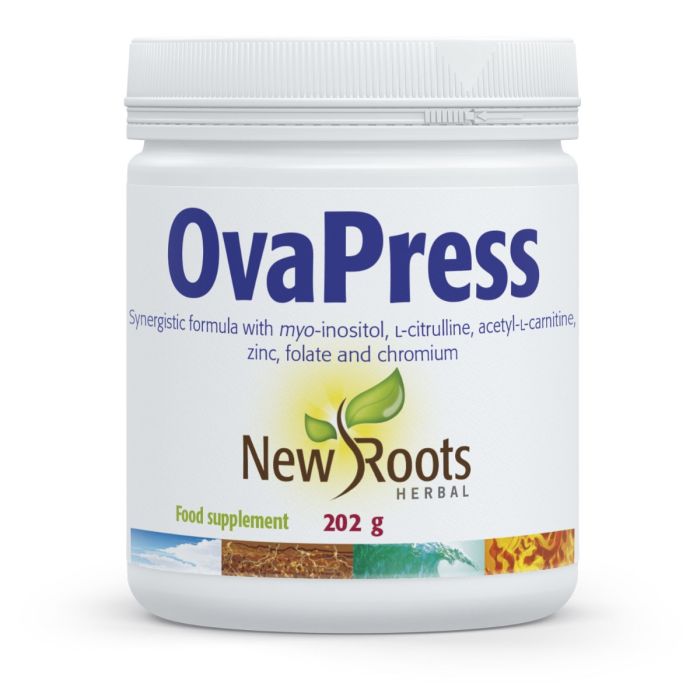
NewRoots Herbal’s OvaPress promotes healthy glucose metabolism and improves ovarian function in women with oligomenorrhoea and polycystic ovary syndrome (PCOS).
Inositol plays a fundamental role in reproductive physiology. It acts as a direct messenger for insulin and improves glucose uptake in various reproductive tissues (1). It also participates in follicular maturation with the progression of the menstrual cycle and in embryogenesis processes, such as neural tube closure (2,3).
INGREDIENTS:
INOSITOL: a meta-analysis of randomised trials investigated the treatment of anovulation in women with PCOS using inositol(4). This study included 10 randomised controlled trials with a total of 362 women taking inositol (257 with myo-inositol and 105 with D-chiro inositol), 60 with metformin (an antidiabetic drug) and 179 with placebo. Treatment with inositol significantly improved the ovulation rate compared to placebo. Inositol was also associated with a higher frequency of menstrual cycles compared to placebo.
A meta-analysis of randomised controlled trials investigated the effects of myo-inositol alone or in combination with D-chiro inositol on endocrine and metabolic abnormalities in women with PCOS (5). The nine randomised controlled trials, which included 247 inositol cases and 249 controls, found a significant decrease in fasting insulin (p = 0.009) and the homeostasis model assessment index (HOMA) (p = 0.041) after supplementation with myo-inositol. The study also found a slight trend toward a reduction in testosterone concentration in individuals treated with myo-inositol compared to controls (p = 0.099). Treatment with myo-inositol for 16 weeks had no significant effect on SHBG (sex hormone-binding globulin, which binds to sex hormones, making them less biologically active) levels compared to controls (p = 0.958), while supplementation with myo-inositol for 24 weeks revealed a significant increase in SHBG levels compared to other treatments (p = 0.026).
The effect of myo-inositol, compared to metformin (an antidiabetic drug), on hormonal and glycolipid profiles in women with polycystic ovary syndrome (PCOS) has been the subject of several studies. A systematic review and updated meta-analysis of randomised controlled trials included a total of 9 studies with a total of 612 patients with PCOS, of whom 306 were treated with myo-inositol and 306 with metformin (6). Compared to metformin, myo-inositol was more effective in reducing triglyceride levels (p = 0.0001) and avoiding side effects (p < 0.00001). No significant differences were found between myo-inositol and metformin in terms of indicators related to body fat, glycolipid metabolism, and glucose metabolism (in particular, HOMA-IR and FINS).
Myo-inositol has also been studied as a pretreatment for women without PCOS undergoing in vitro fertilisation (IVF) cycles (7). In a randomised controlled trial involving 100 patients without PCOS undergoing IVF, the addition of 4 g/d of MI to the control treatment of 150 IU/d of follicle-stimulating hormone (FSH) and 400 µg of folate resulted in a significantly lower amount of exogenous FSH required to achieve follicular maturation (8). A prospective controlled observational trial investigated 3 months of pretreatment with 4 g/d of myo-inositol and 400 µg/d of folate or folate alone in 76 patients without PCOS who responded poorly during IVF (9). Treatment with myo-inositol resulted in a higher number of oocytes retrieved in metaphase II (MII) (p = 0.01) and a higher ovarian sensitivity index to gonadotropins (p < 0.05), suggesting a role for myo-inositol in improving ovarian response to gonadotropins.
Clinical trials show that taking 4 grams of myo-inositol a day helps to normalise ovulation in women with polycystic ovary syndrome (PCOS). PCOS is a common cause of infertility, with symptoms including irregular periods, failure to release an egg during the menstrual cycle (anovulation), ovarian cysts and unwanted hair growth following a male-pattern distribution.
Myo-inositol improves insulin sensitivity, which is one of its most important benefits in alleviating PCOS by stimulating the growth of ovarian cells and embryonic development. It reduces oxidative stress, restores ovulation and oocyte quality, normalises the menstrual cycle and reduces serum testosterone levels in women with PCOS (10–13).
L-CITRULLINE: L-citrulline is a non-essential amino acid involved in the urea cycle and a precursor of L-arginine, playing an indirect role in the synthesis of nitric oxide. In the context of polycystic ovary syndrome (PCOS), its significance is primarily physiological, due to its potential contribution to supporting vascular function and cardiometabolic balance, particularly in women with insulin resistance (14–16).
The available clinical evidence shows that oral supplementation with L-citrulline may improve certain vascular parameters and reduce blood pressure in specific population groups, although these findings are not specific to women with PCOS. In reviews on cardiometabolic health, citrulline has been proposed as an amino acid of interest due to its role in the bioavailability of arginine and nitric oxide, but its application in PCOS remains indirect (17,18).
L-CARNITINE: A systematic review included six articles to assess the potential role of carnitine in women with PCOS. Two observational studies showed that serum carnitine levels were inversely related to glycaemic status, body mass index and waist circumference. Four clinical trials examining the effect of carnitine supplementation in patients with PCOS revealed improvements in weight loss, glycaemic status, oxidative stress, follicle development and ovarian cell size; no significant effects on sex hormones or the lipid profile were reported (19).
In recent years, meta-analyses and molecular biology studies have built on these findings, demonstrating that L-carnitine restores mitochondrial function in ovarian granulosa cells by activating the PI3K-Akt and HIF-1A pathways (20). This optimisation of energy metabolism not only increases endometrial thickness and the number of mature follicles (21), but also significantly raises clinical pregnancy rates in patients with PCOS (21,22). Furthermore, current evidence suggests that long-term treatments do have a secondary positive impact on the lipid profile — reducing triglycerides and LDL cholesterol (23) —, enhancing their metabolic effectiveness when administered in combination with myo-inositol (24).
ZINC: A systematic review and meta-analysis assessed zinc status in patients with PCOS, concluding that affected women have significantly lower plasma and serum zinc levels compared with healthy control groups (25). Various observational studies have shown that this zinc deficiency is inversely related to body mass index (BMI), fasting insulin levels and the homeostatic model of assessment for insulin resistance (HOMA-IR) (25,26). Meanwhile, randomised clinical trials examining the impact of oral zinc supplementation revealed notable improvements in the clinical manifestations of hyperandrogenism, achieving a measurable reduction in alopecia and hirsutism (27). Furthermore, complementary clinical evidence suggests that zinc supplementation optimises carbohydrate metabolism by reducing plasma glucose levels and malondialdehyde (a critical marker of oxidative stress) (27,28). At the ovarian level, recent research in molecular biology suggests that zinc is essential for mitigating follicular apoptosis and mitochondrial dysfunction in ovarian tissue (29). However, meta-analyses of controlled trials agree that supplementation with this trace element alone does not induce drastic short-term changes in gonadotropin profiles or HDL cholesterol levels (28,30).
FOLATE (5-MTHF): Folate plays a well-established role in the prevention of neural tube defects (31). A retrospective study of women undergoing assisted reproductive technology linked supplementation with 5-methyltetrahydrofolate (5-MTHF or calcium L-methylfolate) and vitamin B12 with a possible improvement in embryo development and better pregnancy outcomes (32). In this study, 111 women received 5-MTHF and vitamin B12, whilst 158 women received folic acid alone. The 5-MTHF plus vitamin B12 group had a higher percentage of clinical pregnancies and live births compared with the folic acid group (p = 0.01 and p = 0.02, respectively). The mean number of oocytes in metaphase II (MII) and the 2PN fertilisation rate (FR) in the 5-MTHF plus vitamin B12 group were higher compared with the folic acid-only group (p = 0.04 and p = 0.05, respectively) (32).
In the specific context of PCOS, the use of the active form 5-MTHF is particularly important due to the high prevalence of insulin resistance and hyperhomocysinaemia in these patients (33). Whilst synthetic folic acid requires multiple enzymatic steps dependent on dihydrofolate reductase (DHFR) and methylenetetrahydrofolate reductase (MTHFR) to become active, 5-MTHF bypasses these metabolic barriers and is taken up directly by granulosa cells (34). Clinical trials indicate that this metabolically active supplementation not only significantly reduces serum homocysteine levels — a marker negatively associated with oocyte quality — but also concurrently reduces biomarkers of oxidative stress and improves insulin sensitivity (HOMA-IR) in women with PCOS (33,35). This response optimises the follicular microenvironment without overloading the hepatic pathways, thereby counteracting the harmful accumulation of unmetabolised folic acid (UMFA) commonly seen in high-dose treatments (34,36).
CHROMIUM: Two randomised, double-blind, placebo-controlled studies examined the effect of 12 weeks’ supplementation with 200 µg/day of chromium picolinate plus 1,000 mg/day of carnitine, or placebo, in 54 overweight and obese women with PCOS (37,38). Study participants who received carnitine and chromium had significantly lower levels of total testosterone (p = 0.002) and hirsutism (excessive hair growth in women) (p = 0.02) compared with the placebo group. Furthermore, co-supplementation with carnitine and chromium reduced weight, BMI, fasting plasma glucose, insulin resistance, triglycerides, and total and LDL cholesterol, whilst increasing insulin sensitivity. Co-supplementation resulted in lower levels of high-sensitivity C-reactive protein (a marker of inflammation) and malondialdehyde (a marker of oxidative stress), and higher levels of total antioxidant capacity. Furthermore, supplementation positively regulated the gene expression of interleukin-6 (IL-6) and tumour necrosis factor-alpha (TNF-α) compared with placebo.
Beyond the specific effects of its combined administration with carnitine, the overall scientific evidence confirms chromium as an insulin sensitiser of great clinical relevance for PCOS. At a molecular level, chromium picolinate exerts its primary function by optimising the insulin signalling pathway through the enhancement of insulin receptor (IR) phosphorylation and the translocation of GLUT-4 transporters to the cell surface of muscle and adipose tissue (39). Recent meta-analyses of controlled clinical trials confirm that chromium supplementation alone significantly reduces fasting insulin levels, lowers inflammatory markers and the HOMA-IR index, and, at appropriate doses, achieves metabolic effects and ovulation induction rates comparable to those of metformin, but with a drastically lower incidence of gastrointestinal side effects (40).
References: