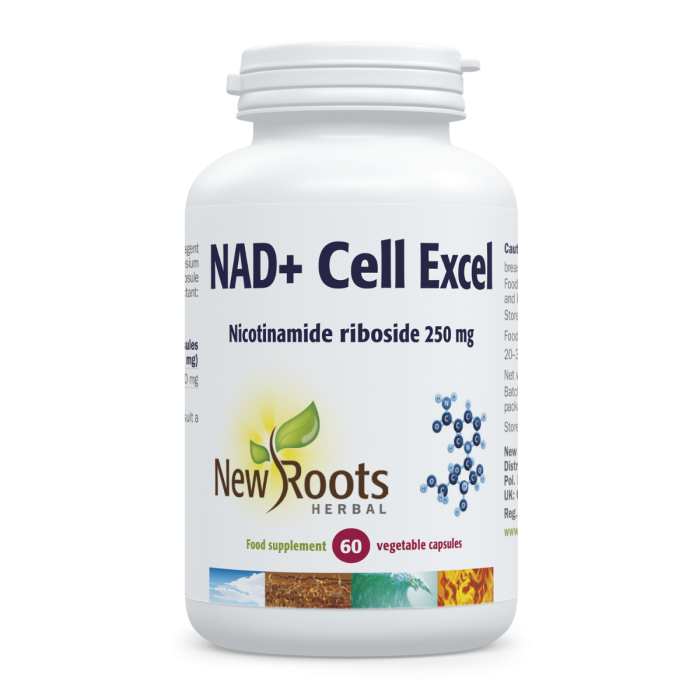
Discover the power of nicotinamide riboside (NR), the bioactive form of vitamin B3, vital for cellular health. This coenzyme, clinically proven to raise NAD+ levels, boosts energy production and supports cell cycle regulation, improving metabolic function.
By supporting the mitochondria (our cellular powerhouses), nicotinamide riboside (NR) boosts the production of ATP, the body's primary energy molecule. It protects cells from damage and oxidative stress, fighting the signs of ageing. As NAD+ declines with age, supplementation becomes essential for vitality and healthy ageing.
NAD+ Cell Excel is perfect for those seeking increased cellular energy.
INGREDIENTS:
NICOTINAMIDE RIBOSIDE: is a form of vitamin B3 and one of the most studied precursors of nicotinamide adenine dinucleotide (NAD+) (1). NAD+ was originally discovered in 1906 as a fermentation-enhancing factor in yeast extracts, but was later found to be a nucleotide involved in oxidation-reduction reactions in the body (2). NAD+ is depleted due to stress, ageing, DNA damage, oxidative stress, inflammation, etc. (3). This depletion can be compensated by the process of synthesis from tryptophan or four other precursors, one of which is nicotinamide riboside (4). Nicotinamide riboside is converted to NAD+ in a two- or three-step process, much faster than synthesis from tryptophan, which requires eight steps (4). In fact, consuming a single 1,000mg dose of nicotinamide riboside results in a 2.7-fold increase in blood NAD+ levels (5).
Researchers found that nicotinamide riboside protected mice from weight gain, improved their insulin sensitivity and increased the mitochondrial content of their skeletal muscle (2). Independent animal studies also showed that nicotinamide riboside could activate the SIRT1 gene, which is involved in healthy ageing, cell survival and metabolic control. Through this activation, nicotinamide riboside was able to protect against cardiac hypertrophy and reduce systolic blood pressure in murine models (4).
Nicotinamide riboside supplementation in animal models of Alzheimer's disease improved cognition and attenuated brain degeneration by inhibiting beta-amyloid accumulation in the brain. This is achieved by increasing NAD+ levels, which help combat oxidative stress and promote DNA repair (4).
Nicotinamide riboside has also been shown to improve liver health. Not only does it promote hepatocyte replication and increase hepatic ATP content, but it also reduces lipid accumulation in the liver (2). This is achieved by decreasing the activity of the NLRP3 inflammasome, which promotes inflammation, and by inducing the mitochondrial unfolded protein response, essential for the maintenance of mitochondrial protein homeostasis (2).
Clinical trials have begun to investigate the association between nicotinamide riboside supplementation and muscle composition, inflammation and Parkinson's disease (see Table 1). Specifically, it has been shown to increase lean body mass in obese subjects, reduce circulating inflammatory cytokines and provide mild cognitive improvements in people with Parkinson's disease (6-8). These preliminary investigations reiterate that age-associated alterations in NAD+ homeostasis can be ameliorated by nicotinamide riboside supplementation.
In general, nicotinamide riboside has shown excellent safety and tolerability in human trials (9). It has a higher oral bioavailability than other NAD+ precursors, such as NAM and nicotinic acid, demonstrating that it is the best source of NAD+ (9).
Table 1. Human clinical trials:
|
Study design
|
Results
|
Ref
|
|
Muscle composition and fitness
|
|
Thirteen overweight or obese subjects were randomly given 1,000 mg/day of nicotinamide riboside or placebo for 6 weeks.
|
Nicotinamide riboside supplementation increased lean body mass and metabolic rate during sleep. In addition, acetylcarnitine concentrations in skeletal muscle increased with supplementation.
|
6
|
|
Anti-inflamatory
|
|
Twelve elderly men were given either a 1,000 mg nicotinamide riboside supplement or placebo every day for 21 days in a randomised, double-blind, crossover trial.
|
Subjects receiving nicotinamide riboside had an elevated muscle NAD+ metabolome and reduced levels of circulating inflammatory cytokines. This suggests that nicotinamide riboside has anti-inflammatory effects in human muscle tissue.
|
7
|
|
Parkinson's disease
|
|
Thirty treatment-naive study participants with Parkinson's disease were given either 1,000 mg nicotinamide riboside or placebo for 30 days.
|
Study subjects who received nicotinamide riboside and showed elevated brain NAD levels had altered brain metabolism. This was associated with mild clinical improvements and decreased levels of inflammatory cytokines.
|
8
|
References:
1) Custodero, Carlo, et al. "Nicotinamide riboside—A missing piece in the puzzle of exercise therapy for older adults?." Experimental gerontology 137 (2020): 110972. 2) Yoshino, Jun, Joseph A. Baur, and Shin-ichiro Imai. "NAD+ intermediates: the biology and therapeutic potential of NMN and NR." Cell metabolism 27.3 (2018): 513-528. 3) Podyacheva, Ekaterina, and Yana Toropova. "Nicotinamide riboside for the prevention and treatment of doxorubicin cardiomyopathy. Opportunities and prospects." Nutrients 13.10 (2021): 3435. 4) Mehmel, Mario, Nina Jovanović, and Urs Spitz. "Nicotinamide riboside—the current state of research and therapeutic uses." Nutrients 12.6 (2020): 1616. 5) Braidy, Nady, and Yue Liu. "Can nicotinamide riboside protect against cognitive impairment?." Current Opinion in Clinical Nutrition & Metabolic Care 23.6 (2020): 413-420. 6) Remie, Carlijn ME, et al. "Nicotinamide riboside supplementation alters body composition and skeletal muscle acetylcarnitine concentrations in healthy obese humans." The American journal of clinical nutrition 112.2 (2020): 413-426. 7) Elhassan, Yasir S., et al. "Nicotinamide riboside augments the aged human skeletal muscle NAD+ metabolome and induces transcriptomic and anti-inflammatory signatures." Cell reports 28.7 (2019): 1717-1728. 8) Brakedal, Brage, et al. "The NADPARK study: A randomized phase I trial of nicotinamide riboside supplementation in Parkinson’s disease." Cell metabolism 34.3 (2022): 396-407. 9) Johnson, Sean, and Shin–ichiro Imai. "NAD+ biosynthesis, aging, and disease." F1000Research 7 (2018): 132.