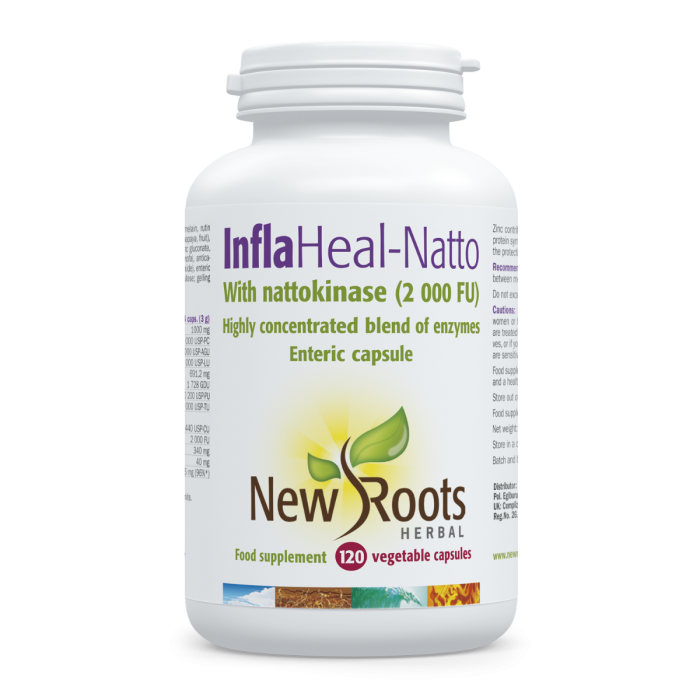
InflaHeal-Natto is a combination of digestive enzymes, mostly of the proteolytic and metabolic sort, antioxidants and amino acids and now with the enzyme nattokinase.
The enzymes contained in InflaHeal-Natto favour the effective digestion of protein, carbohydrates and fat, dissociating food molecules and facilitating nutrient absorption in the blood, improving digestion. They also catalyse different chemical reactions in cells, organs and tissues, deactivating molecular components during inflammatory processes, while antioxidants attack and remove the free radicals produced in the process.
The formula places great importance on proteolytic enzymes, which break down proteins and prepare them for proper absorption. In addition to aiding digestion, these enzymes have been shown to have anti-inflammatory properties. Protein digestion is very important because particles that are not properly digested can enter the bloodstream along with other nutrients and cause various allergic reactions, as well as promoting the formation of toxic substances produced during putrefaction. Proteins that are not digested properly cause inflammation in the body.
Proteolytic enzymes are important for preventing tissue deterioration during inflammation. They favour the breakdown of fibrin and prevent its clotting. Fibrin stimulates inflammation, forming a wall around the inflamed area, blocking the flow of blood and lymph that cause swelling and can also lead to the development of blood clots, which can detach and cause cerebral embolism or heart attack.
This combination promotes good digestion when taken before meals, helping reduce feelings of stomach discomfort and heaviness. When taken between meals, the ingredients in this formula work to reduce the inflammation that causes tissue damage.
INGREDIENTS:
PANCREATIN: Pancreatin is a preparation of pancreatic enzymes isolated from fresh pig pancreas. Pancreatin is used to replace digestive enzymes when the pancreas does not produce enough on its own. Certain medical conditions can cause this lack of enzymes, including cystic fibrosis, chronic inflammation of the pancreas, pancreatic cancer or pancreatic surgery. Pancreatin can also be used to treat steatorrhoea (loose, fatty stools) (1,2). Pancreatin provides amylase, protease and lipase:
Amylase: Amylase intervenes in the breakdown of starch and carbohydrate molecules into smaller sugars. The different types of amylase dissociate molecules of different types of sugars, lactase dissociates lactose (milk sugar), maltase dissociates maltose (malt sugar) and sucrase dissociates sucrose (cane and beet sugar) (3-5).
Protease: Protease intervenes in protein digestion and its breakdown into simple amino acids. Protease enzymes, like other digestive secretions, are responsible for maintaining the small intestine free of parasites. A lack of protease enzymes increases the risk of intestinal infection. These include trypsin, chymotrypsin and carboxypeptidase (6,7).
Lipase: along with bile, intervenes in fat digestion. A deficiency in pancreatic lipase results in poor absorption of fat and soluble vitamins. The action of pancreatin is favoured by the presence of the enzymes bromelain and papain (8,9).
BROMELAIN: It promotes the digestion of proteins, thus facilitating the absorption of nutrients into the blood and improving digestion. It also catalyses various chemical reactions in cells, organs and tissues by deactivating molecular components in inflammatory processes. Bromelain is also helpful in cases of cardiovascular and respiratory diseases (10,11).
Bromelain is an enzyme that digests proteins with enormous resistance to the breakdown processes that occur in the gastrointestinal tract. If taken before meals, it promotes the digestive process, reduces stomach discomfort and the feeling of fullness. Between meals it acts as an anti-inflammatory and thus protects the tissues (12,13).
It may also be of interest as part of a balanced weight control programme in conjunction with a low-fat diet and balanced physical activity (13).
Bromelain has anti-inflammatory effects because it blocks the synthesis of certain tissue hormones (type 2 prostaglandins), which are involved in the development of inflammatory processes. It stimulates the production of plasmin, which not only blocks the formation of inflammation-promoting compounds, but also breaks down fibrin, thus preventing the formation of swelling. Hence its use in cases of rheumatoid arthritis, osteoarthritis and other inflammatory processes. Also for sports injuries it can considerably reduce the recovery phase, as the product acts against swelling, as well as moderating/palliating bruises, sprains, strains and contusions (10,12,13).
Bromelain has been shown in many studies to be highly effective against inflammatory and immunological processes (13,14).
In addition to its antibiotic properties, it is of great help against respiratory tract infections in the treatment of sinusitis, pneumonia and bronchitis. It also has a possible anticancer effect, especially after chemotherapy, by inhibiting the proliferation of cancer cells (15).
Bromelain not only metabolises proteins, but can also ameliorate damage to the walls of veins and arteries caused by inflammatory processes, as well as preventing the clumping of platelets. Its fibrinolytic properties have very positive effects on thrombophlebitis, arteriosclerosis, lymphatic oedema and varicose veins. (11,13,16).
The positive effects of bromelain are enhanced by the simultaneous intake of pancreatin (its anti-inflammatory effect helps the body's response to swelling and inflammation and to remove deposits that may form in the joints, as well as shortening recovery time) (synergistic effect) (10).
PAPAIN: is an enzyme obtained from papaya latex, and is able to digest proteins into peptides or even amino acids, stimulating pancreatic juices for better protein digestion. It can help digest wheat gluten, which may be beneficial in people with coeliac disease (17-20). It also has the ability to digest starch and, to a lesser extent, fats.
Papain helps to relieve sports injuries (21-22), has analgesic and anti-inflammatory activity (23) including against symptoms of acute allergic sinusitis (24).
Papain breaks down the fibrin wall of the cancer cell. This makes the cancer cell more vulnerable to chemotherapy. Several studies against various types of cancer cells have shown activity against these cells (25-28).
TRYPSIN AND CHYMOTRYPSIN: Trypsin is an enzyme that acts to break down proteins and is often referred to as a proteolytic enzyme or proteinase Trypsin is one of the three main digestive proteinases, the other two being pepsin and chymotrypsin. In the digestive process, trypsin acts with the other proteinases to break down dietary protein molecules into their component peptides and amino acids. Trypsin and chymotrypsin are powerful enzymes that degrade proteins efficiently.
Clinical studies show that the anti-inflammatory effect of trypsin is possibly due to its inhibitory action on vascular permeability (29) and its ability to inhibit the increase in C-reactive protein and enhance the increase in alpha 1-antitrypsin, alpha 2-macroglobulin (30). Trypsin-chymotrypsin has also been shown to modulate cytokine levels in burns (31).
RUTIN: A bioflavonoid coming from the eucalyptus tree, rutin has antioxidant and antiinflammatory properties (32-34).
L-CYSTEINE: This is an amino acid with antioxidant characteristics which acts on the liquid area surrounding cells throughout the body. L-cysteine also maintains a balance of reduced glutathione (GSH), which is part of each and every cell. Any disturbance in the GSH balance can aid the destruction or death of damaged cells. It helps in collagen production (35-37).
ZINC: This mineral acts mainly as a co-enzyme of the antioxidant enzyme superoxide dismutase, or SOD. It has significant antioxidant power which acts mainly by preventing fat oxidation (38-40).
NATTOKINASE: is a serine proteolytic enzyme (subtilisin), traditionally obtained from natto (soy fermented with Bacillus subtilis var. natto), with marked fibrinolytic activity and used as a supplement for cardiovascular health (41). It directly hydrolyses fibrin and plasmin substrates, promoting the dissolution of clots (42).
In human studies, oral administration of nattokinase (dose of 2,000 FU) increases fibrinolysis parameters (D-dimer, fibrin/fibrinogen degradation products) and moderately prolongs activated partial thromboplastin time, appearing to improve fibrinolysis and anticoagulation through several different pathways simultaneously (43).
Several studies point to nattokinase as a promising oral antithrombotic agent for the prevention of cardiovascular events, combining fibrinolytic action, mild anticoagulation, and a potential effect on blood pressure and blood viscosity, although the evidence remains limited and based on small studies (44,45).
In summary, nattokinase is a fibrinolytic protease with well-characterised mechanisms (direct fibrin degradation, activation of plantillthe plasminogen/tPA system and reduction of PAI-1), with preliminary clinical data supporting its use as an antithrombotic and cardioprotective adjuvant.
References:
1) Beck, I. T. "The role of pancreatic enzymes in digestion." The American journal of clinical nutrition 26.3 (1973): 311-325. 2) Hernandez-Ledesma, Blanca, et al. "Identification of bioactive peptides after digestion of human milk and infant formula with pepsin and pancreatin." International Dairy Journal 17.1 (2007): 42-49. 3) d'Eril, GV Melzi, T. Bosoni, and C. Lesi. "Pancreatic amylase in serum for differential diagnosis of acute pancreatitis and acute abdominal diseases." Clinical chemistry 35.10 (1989): 2142-2143. 4) Van Lente, F., and S. C. Kazmierczak. "Immunologically-derived pancreatic amylase, pancreatic lipase, and total amylase compared as predictors of pancreatic inflammation." Clinical chemistry 35.7 (1989): 1542-1542. 5) Werner, Mario, William M. Steinberg, and Carol Pauley. "Strategic use of individual and combined enzyme indicators for acute pancreatitis analyzed by receiver-operator characteristics." Clinical chemistry 35.6 (1989): 967-971. Further literature references can be found in the product information sheet.